Fountain Path Matten


- 1:00 h
- 1.56 km
- 3 m
- 4 m
- 571 m
- 575 m
- 4 m
- Start: Beundenhaus Matten
- Destination: Beundenhaus Matten
Fountain “Mattenkreuz”
The name refers to the street intersection or the wayside cross (crucifix) that stood above the stone grotto during the Catholic period. Later road expansion required moving the fountain to the hillside. The water of the Matten fountains comes from their own spring intakes. The Interlaken Monastery began building the spring intakes in the 15th
century on the territory of the neighboring community of Wilderswil. A dedicated pipeline system supplies the fountains.
Fountain “Baumgarten”
Until about 150 years ago, many parts of Matten lay in an orchard forest. The Baumgarten fountain, made from Ringgenberger alpine limestone, is a gift from master builder Fritz Kübli. His tree company received the commission from the community to construct the first stages of the modern sewage system.
Fountain “Brunngasse”
In Matten, many agricultural businesses belonged to the Interlaken Monastery. The livestock had to be watered. Therefore, the monastery decided to build fountains. In the Brunngasse, there used to be several wooden fountains in earlier times.
At the beginning of the 20th century, tourism experienced a boom. As a result, the community was financially able to renew the fountains. The “Brunngasse” fountain was built in 1909 along with seven others and is decorated with Art Nouveau patterns.
Fountain “Dorfstrasse”
The fountain on Dorfstrasse is the oldest of the 18 existing Matten fountains today. The double fountain was built in 1826 by Peter Tschiemer from Goldswil slabs. It still serves as a watering place for livestock and horses.
Our region lives surrounded by glaciers, mountain lakes, rivers, streams, and springs, dependent on and with water. Every year, tens of thousands of tourists spend their holidays directly and indirectly with water activities: snow sports, ice climbing, hiking along lakes and rivers, lake cruises, swimming sports, canyoning, river rafting.
Fountain “Hofstatt”
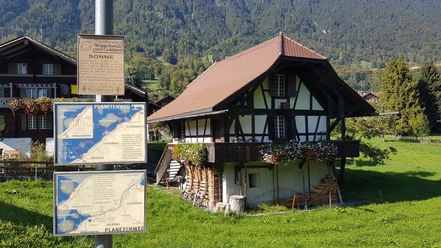
The so-called Hofstatt was once owned by the richest Matten farmer. The barn that still exists today belonged to a farmhouse which now stands in the Ballenberg open-air museum.
The owner, Hans Sterchi, was politically active in the community in the 19th century. His commitment to building a schoolhouse was rejected by the municipal council. Undeterred, he built the first schoolhouse in Matten on his property together with the population and with his own financial means. The former school building stands to the left of the fountain and fittingly carries the name “Brunnenhaus” (fountain house).
Fountain “Pfandstatt”
With the construction of the new senior citizens' apartments in 1996, the youngest fountain in Matten was built. The stone used came from the Grimsel area and was worked by the stone carving from Bergen in Guttannen. The name Pfandstatt used to refer to a building where pawned items or livestock were secured. The second Matten schoolhouse, now a kindergarten, was located at this place.
An anecdote from the first half of the 20th century tells that in a harsh winter the toilet water (then an outhouse) froze. Teacher August Flückiger took action and “cleared the way” by shooting with his army rifle. The students then again had a functioning toilet.
Fountain “Unterdorf”
Until modern times, the fountain served as a drinking water source. People carried water home in containers made of wood and metal (“Bränten”). On the front side, opposite the outlet, there was a small trough. The large fountain trough served as livestock watering, and only the so-called “Sudeltrögli” was allowed to be used for laundry according to municipal law.
Until World War II, water was bottled in glass bottles and sold to surrounding hotels. The fountain path now leads through the “old Unterdorfstrasse”, a typically narrow village lane. On the right is the oldest Matten house, the Kübli house from the 16th century. This is followed by the Aemmer house from the 17th century.
Fountain “Mattenwirtshaus”
Across from the fountain is the Mattenwirtshaus – today called Landgasthof Hirschen – one of the oldest inns in the region. Already in 1242, a smithy with a right to serve wine stood at this location. The lower part of today's building was built in 1683. In the following centuries, several new additions were made.
The fountain is not supplied through the actual monastery fountain pipeline but by its own pipeline. An ancestor of the innkeepers, Christian Sterchi, distinguished himself for bravery in the Battle of Villmergen in 1712. As a reward, the Bernese government allowed him to build a fountain with its own water supply in front of his inn.

Good to know
Pavements
- Street (100%)
Best to visit
- suitableDepends on weather
Directions & Parking facilities
- ParkingParking lot Tellspiele Interlaken/Matten
Additional information
- www.brunnendorf.ch
License (master data)
Nearby



Download GPX file